Mould in bathrooms and kitchens: causes and ways to limit its growth
EV Sun team · 14/11/2026 · 5 min read
Damp, warmth and poor ventilation encourage mould. Here are practical steps you can take every day.
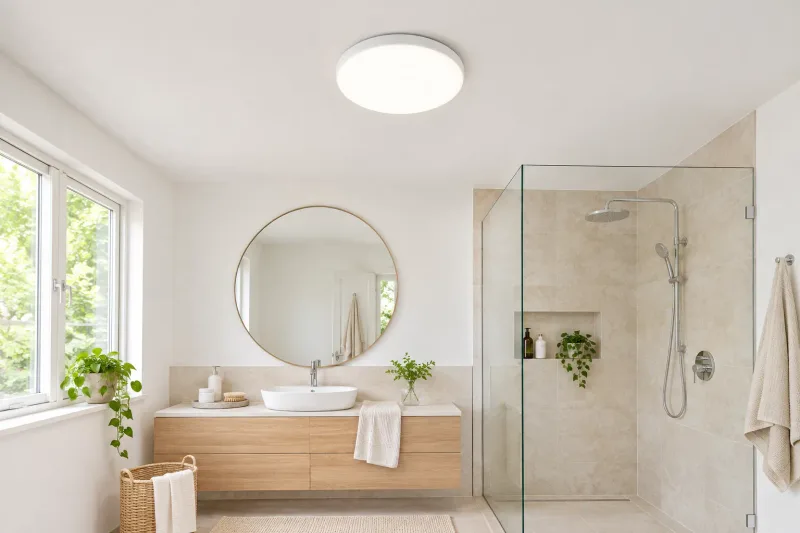
Mould most often appears where moisture persists: around windows, on grout, behind furniture or in wall corners. Spores circulate in the air and settle on surfaces. Changing the lighting can complement everyday measures, but it cannot fix a leak, a thermal bridge or a ventilation problem.
Before choosing a luminaire, establish where moisture builds up and when. A bathroom after a shower needs different attention from a wall that stays damp regardless of how the room is used. Identify the cause first, then select lighting to suit the conditions and installation location.
Common causes
- Steam from bathing and cooking that remains in the room.
- Poor ventilation or blocked extract vents.
- Cold sections of wall and thermal bridges where condensation forms.
- Infrequent airing and drying laundry in small, enclosed spaces.
Noting where and when damp appears will help when speaking to someone who can check the ventilation or building fabric. Do not simply cover the problem with fresh paint or assume an extra light will replace a necessary repair. Select lighting alongside measures to address the causes of damp.
Everyday steps
Air rooms briefly and thoroughly, keep extract vents clear and watch for moisture after bathing or cooking. Keep indoor humidity within the recommended 40–60% range. Wipe grout and silicone after bathing. Avoid drying laundry in small, enclosed rooms where moisture lingers.
In kitchens, check behind fitted units, around windows and near surfaces where steam condenses. In bathrooms, watch corners and areas around the bath and shower. Recurring damp needs its cause identified even after visible marks have been removed.
The role of EVLN technology
While an EV Sun luminaire is switched on, EVLN technology reduces and limits bacteria, fungi and mould in the air and on surfaces. Ordinary visible LED light activates the coating. No additional mode is needed. UV-free and ozone-free, the luminaires can operate throughout the day while people are at home.
This does not dry out walls or remove the cause of mould. We describe the role of lighting separately from ventilation and repair work. If the problem returns in the same place, room conditions still need checking; switching on a luminaire does not resolve every underlying cause.
What the tests measured
In IBPRS test, airborne mould and yeast counts fell from 97 to 14 CFU/m³ (85.57%) after three 6000 K luminaires had been on for 24 h. The room was 9 m² and 2.9 m high. The luminaires were mounted on the ceiling and the air sampler was 1 m above the floor. IBPRS test: 3 luminaires in a 9 m² room, measured before switch-on and after 24 h of light. Test details
- IBPRS report (6000 K): airborne mould and yeast counts fell from 97 to 14 CFU/m³ after 24 h (−85.57%).
- Airborne microorganisms: −92% after 24 h in a 9 m² room with 3 luminaires; Instytut Biotechnologii Przemysłu Rolno-Spożywczego, Łódź.
- The coating works in everyday use while the luminaire is switched on.
- Find the full measurement details in the Research section.
A test percentage does not promise the same result in every bathroom. The conditions in the particular room, number of luminaires and operating time all matter. When comparing information, look for the full test description rather than just a prominently displayed figure.
Match the luminaire to its installation location
For bathrooms outside zones 0–2, the EVLN‑SDL 4,000 K surface-mounted luminaire (IP20); above showers and baths, the EVLN‑VL weatherproof luminaire (IP65).
This distinction matters when choosing a product. The EVLN‑SDL surface-mounted luminaire is intended for dry rooms and has an IP20 rating. The EVLN‑VL weatherproof luminaire has an IP65 rating and is intended for damp and dusty locations. Do not assume that every luminaire has the properties of a weatherproof model simply because it uses EVLN technology.
- EVLN‑SDL: surface-mounted luminaire, IP20, for dry locations outside zones 0–2.
- EVLN‑VL: weatherproof linear luminaire, IP65, for damp and dusty locations.
- Specified colour temperature for the bathroom EVLN‑SDL luminaire described here: 4,000 K.
- Power, luminous flux and dimensions: check the specifications for the selected product variant.
Before installation, check the instructions and site conditions. A suitably qualified person should select the location and make the electrical connection. Also consider how much light is required: the IP rating describes enclosure protection, not how many luminaires will light the whole bathroom.
Preparing an enquiry
In Luminaire selection, choose the room conditions, then enter the dimensions in the Lighting calculator. When enquiring through Contact, add the intended installation location and details of any moisture. Compare dimensions, power and luminous flux on the EVLN‑VL and EVLN‑SDL product pages.
If your enquiry covers several locations, describe each separately. A dry corridor, a kitchen and the space above a shower are different applications. These details help you compare suitable products and avoid choosing a luminaire on appearance alone.
Frequently asked questions
Can a luminaire replace work to address the cause of damp? No. A leak, inadequate ventilation or a damp wall still needs investigation and repair. Treat EVLN technology as part of the lighting, working while the light is on.
Is every EV Sun luminaire suitable above a bath? No. Check the IP rating and installation location. IP20 luminaires are not equivalent to the IP65 EVLN‑VL weatherproof model. Follow the instructions for the specific model.
Where can I check the conditions behind the mould result? Open Research. Remember that the stated result applies to a 9 m² room, three luminaires and measurement after 24 hours, rather than any installation.